Tuesday, November 3, 2015

The History of Smoking - Ad Analysis Paper Rough Draft

Leah Nieman
English 101 – 5:30 pm – Rough Draft Analysis Paper #1
Sonia Begert
11/2/15

The History of Smoking

           A single advertisement has the ability to persuade and change the mindset of the people that view it. Most advertisements are based on facts, trying to convince the public to buy a company’s product or the opposite, but are these facts always reliable? Should we put our trust into them? In almost all ads, behind the facts are hidden impressions or meanings. In this essay I will be comparing two different smoking ads that are over half a century apart.
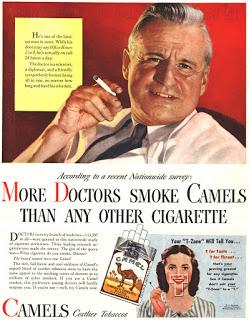
The first ad is dated back to 1946 when it was published by the magazine Life, a popular magazine that would be read by millions. The advertisement is split in half, with a picture above, and an article below. The image that is featured above is a man in physicians clothing, posed relaxed and leisurely smoking a Camel cigarette, looking as if he is taking a break in between patients. The man has a kind look, almost grandfatherly, and gives you the impression that the people being treated by this physician are in good hands. The background is red, and there is a contrasting yellow text box next to the physician saying, “The doctor is a scientist, diplomat, and a friendly sympathetic human being all in one, no matter how long and hard his schedule." This quote leaves the readers with a feeling of safety, but that’s not all this quote is conveying. It is also silently but directly pointing out that the Camel cigarettes are to attribute to him staying “a friendly sympathetic human being” all throughout his “long and hard” schedule.
Then to confirm this direct but silent persuasion towards Camel cigarettes, there is this large, shocking, and almost assumptive quote on the lower half of the advertisement in bold capitalized letters, “According to a recent Nationwide survey: More doctors smoke Camels than any other cigarette.” Not only does this statement shock the audience, but it also gives a sense of awe. An awe toward the product, and an awe that such important people like doctors would choose Camel to be their priority cigarette. The public then immediately start to affiliate health with smoking. This statement is then followed by a short article about the nationwide survey and also displays an open, alluring box of Camel cigarettes. At the bottom right corner there is also a woman, smoking, with a large capitol T across her mouth. Then by her it states, “Your T-zone will tell you…T for taste….T for throat,” signifying that Camel cigarettes will stimulate your “T-zone”. Then at the very bottom of the advertisement is the products key phrase, “Camels – Costlier Tobaccos.”
During the time of this advertisement, studies had just announced that smoking could be linked with cancer. The public at this time were worried, and that is when Camel took action. Camel decided to start marketing the “More doctors smoke Camel” advertisements, hosting surveys at medical conventions. These advertisements were to re-assure the public, showing them that people affiliated with health were even smoking, and smoking a certain brand too! Through these ads Camel was very successful, and benefited from them enormously.
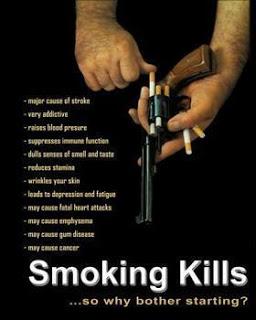
The next ad was published in the year 2005 by a media designer under the name “Katego”. This ad went viral through the internet and social media, reaching countless people. In the ad there is a pitch black background, giving the feel of danger, darkness, and vulnerability. Then there are two hands and a gun. In one hand is the gun, and the gun has cigarettes lodged in the cartridge impersonating bullets. The other hand is inserting the cigarettes into the gun. This image is powerful, for when the audience sees the gun they associate it with harm or death. What causes the harm? In regular cases it would be bullets, but in this image instead of there being bullets, cigarettes are placed in their stead.
As if the image wouldn’t be impacting enough, there is then a list of golden statements to the left of the gun, shining bright against the dark background. The statements include all sorts of negative effects of smoking, saying that smoking is the, “major cause of stroke” and how smoking, “may cause fatal heart attacks, gum disease, and cancer.” And underneath the list and gun, there are these profound words, “Smoking Kills…so why bother starting?”
This ad is to warn the public of the effects of smoking, trying to disintegrate all motive to start. The advertisement also has the ability to encourage the people who are trying to end smoking, reassuring them that by quitting their habit it will be to their best benefit. After viewing the ad, it leaves the audience a little shaken but with confirmation of the danger of smoking.
After looking at these two ads, it is very intriguing to see the difference and change in standards that had taken place in just the last half century. Prior to the 1950s and even extending farther, smoking was one of the most common habits of the public. Smoking was considered a delicacy, and even associated you with high class. At that time smoking was only promoted, even linking smoking to good health. It wasn’t until the mid-1940s that there was even the studies or technology to connect smoking with some of the health problems physicians started facing more and more often. When studies then came back positive towards smoking being related to health problems, there was mass fear. It was during this time when cigarette companies like Camel came up with advertisements reassuring the public of the health benefits of smoking, trying to keep their companies afloat.
Now in our modern day society smoking is looked upon as a harmful habit and something that you should try your best to quit practicing. Most advertisements linked with smoking are negative in our society today, like the one designed by “Katego”, for we now have the technology to know that there are really no healthful benefits of the habit. Smoking has now become rarer, and is now something people do to escape the world and feel happy, or what teenagers and young adults do to establish a feeling of independence. For the people who want to quit, there are now programs and group therapy, encouraging people that they are going down the right path.
Both these ads, though talking about the same subject, are giving two different extremes. One is promoting the health and commonality of smoking, and the other is revealing the harm and negativity of the habit. The public seeing the advertisement in the 1940’s had confidence that the people who were behind the publishing of the ad were telling the truth or implying the truth, and that smoking really was a healthy lifestyle. This is an example of how advertisements can be misleading, and maybe not fully reliable, just so they can convince the public to purchase their product. Now with the rise in technology and the information that we have obtained, we can now look back and learn from history and be able to confirm profound statements that are advertised, without being misled.

Works Cited:
“More Doctors Smoke Camels” Stanford School of Medicine Web. Nov. 3 2015.
Katego’s “Smoking Kills Ad” Deviant Art 2005 Web. Nov 3 2015.
https://blogger.googleusercontent.com/img/b/R29vZ2xl/AVvXsEitJUnJgfaCETo2wbJ9bQ6u8UUCI0HKrz4eICQLzBDKRP9Dmh4hfTFZjIf2cEmvABVRJl7ZA8WvEEYgR5qlG9xBdmNlcVeHh7jB_ggaKgwbDdmAnLichA21uw-kZPNnJm5aY1Q1wGSYkDw/s320/camels_doctors_whiteshirt.jpg

https://blogger.googleusercontent.com/img/b/R29vZ2xl/AVvXsEiVng-GG0Z7hx9Q4tTDYTq5PMzStQKxxlnaViJQc65H38IBp1kRxMHM5MYXPCkk-cPnbw7p8eR1b2KjXWZ50HEZxktg97e3QdDy95bDyj4EVj2_juYVb3h6Szc6D69hpBO75cPLOuOH6lc/s320/Anti_Smoking_Ads_43.jpeg

Thursday, October 29, 2015

Leah Nieman, Holly Snider, Bela Burns

Group ad analysis

Summary: For our English class, we were assigned to analyze an advertisement. The advertisement we chose promotes Dove brand products. In Dove’s advertisement they state how their product is proven to be firming on naturally beautiful women, with the quote, “As tested on real curves.” on the side. This advertisement is part of the “Campaign for Real Beauty”, a group committed to “widening the definition of beauty”.  It shows women outside of the stereotypical norm, different races, sizes, and ages. The women shown in the advertisement display their own type of beauty. This advertisement demonstrates our real society, showing that beauty is in everyone.

Analysis:
The advertisement we analyzed was published by Dove, a brand that creates a vast variety of beauty products for women. This ad was for a specific “firming” product, and they implied that the product is made for women that want to reduce the appearance of aged skin. In this ad there is a white background with six women of all different races and sizes in white undergarments, and all wearing a wide, bright smile. Through the brilliant white background and the racially different women, the audience’s attention is caught. Then, on the right hand side there are these words, “New Dove Firming. As tested on real curves.” In Dove’s advertisement they state how their product is proven to be firming on naturally beautiful women.
            As a group we all concluded that Dove’s purpose for this ad was to boost the self-esteem of the women their product reaches. The diverse women in this ad do not fit the "stereotypical norm", yet they still all look beautiful, and smiling like they know it. We believe that Dove was trying to reach all women, leaving no one out. Dove’s purpose for this ad was to not only promote their product, but also to let women know that this was created for them, tested on women with “real curves”. Overall, we have concluded that this ad conveys that beauty is in every one, and you can see that through the smiles and laughs of the six women in the photo.

            This advertisement of Dove’s is only one of many that conveys this message of beauty, for Dove is a huge part of the “Campaign for Real Beauty”, a group committed to "widening the definition of beauty". It is obvious through this companies ads that they have a purpose of reaching out to women and strengthening their esteem, and their purpose is very honorable. 

Wednesday, October 28, 2015

My Ad Analysis for the Class Presentation

Leah Nieman
10/28/15
English 101 – 5:30
Analyzing Advertisement


Quote: “As tested on real curves.”

Paraphrasing: In Dove’s advertisement they state how their product is proven to be firming on naturally beautiful women.

Summary: For our English class, we were assigned to analyze an advertisement. The advertisement we chose promotes Dove brand products. This advertisement is part of the “Campaign for Real Beauty”, a group committed to “widening the definition of beauty”.  It shows women outside of the stereotypical norm, different races, sizes, and ages. The women shown in the advertisement display their own type of beauty. This advertisement demonstrates our real society, showing that beauty is in everyone.


Leah's Analysis: The advertisement we analyzed was published by Dove, a brand that creates a vast variety of beauty products for women. In this ad there are six women of all different races and sizes, and all wearing a wide, bright smile. Then, on the right hand side there are these words, “New Dove Firming. As tested on real curves.” In Dove’s advertisement they state how their product is proven to be firming on naturally beautiful women. From what we have gathered, this ad is published for all women, leaving no one out. Dove’s purpose for this ad was to not only promote their product, but also to let women know that this was created for them, tested on women with “real curves”. The image that Dove has in their advertisement seems to illustrate that beautiful is not a standard that only super models in the magazines have, but that beauty is in every one, and you can see that through the smiles and laughs of the six women in the photo. This advertisement is only one of many that conveys this message, for Dove is a huge part of the “Campaign for Real Beauty”, and their goal is to boost the self-esteem of the women their product reaches. 

Tuesday, October 27, 2015

In Class Lab - 10/27/15

Holly Snider
Bela Burns
Leah Nieman


Quote: “As tested on real curves.”

Paraphrasing: In Dove’s advertisement they state how their product is proven to be firming on naturally beautiful women.


Summary: For our English class, we were assigned to analyze an advertisement. The advertisement we chose promotes Dove brand products. This advertisement is part of the “Campaign for Real Beauty”, a group committed to “widening the definition of beauty”.  It shows women outside of the stereotypical norm, different races, sizes, and ages. The women shown in the advertisement display their own type of beauty. This advertisement demonstrates our real society, showing women of all types and measurements. 

Monday, October 26, 2015

English 101 - Summarizing, paraphrasing, and quoting

Lurid Numbers on Glossy Pages!

       In Katharine Q. Seelye's analysis, she writes about magazines and one of their greatest tactics: numbers. Numbers in the magazine world are their selling point, they give an attraction to the audience of efficiency. Magazines like Glamour and Cosmopolitan almost always have headings similar to these, "27 ways to get great arms," or, "7 different styles to try out this spring." Headings such as these give the impression that the magazine has done its research. Katharine also states that, "...odd numbers seem to be more believable than even numbers." She talked with editors and she concluded that the reason for odd numbers is that it has a feel of authenticity. To conclude Seelye writes about how half a decade ago numbers were all the rage, and that magazines found huge business with them. It had then died down because of their commonality, but they are now slowly re-approaching, so says Ms. France, editor of Lucky. 


Thursday, October 22, 2015

In-Class Lab: Textual Analysis Paper

Bela Burns, Holly Snider, Leah Nieman

1. Who Published These Ads?

The first ad on the page was published by PETA (People for the Ethical Treatment of Animals), followed by Freedom Of Animals, and Mercy for Animals.

2. Who are these texts intended for? (Or) Who would each one seem to appeal to?

These ads are intended for people who are for animal rights. Each ad was either about treating animals ethically, or using non-animal products. For instance, the PETA ad shows a man cuddling with his dog with wording across saying, "If you wouldn't wear you dog...please don't wear any fur."

3.How can we tell that?

We can tell that these ads were for the public who are interested in animal rights because it appealed to their emotions. The ad from Mercy for Animals really appeals to readers emotions by showing a forlorn pig in a cage with the advertisement saying, "Do you support cruelty to animals? Walmart Does." This deliberately casts shame on the company of Walmart and hooks the reader by making them feel sorry for the animals "Walmart" supposedly is cruel to.  


4. What is the purpose of these texts? What are their creators wanting to change or make happen?

The organizations that created these ads wanted to make people aware that animals are suffering and we are supporting it. The three ads we analyzed all told us that we were causing animals to die either for beauty products, clothing and accessories, or food. We believe that the change the organizations wanted was to have the public's opinions change about buying certain products that supported animal harm.  

5.How do they seem to be working toward that purpose(s)? What beliefs and values do they address? Think: What are their ethical, emotional, and rational appeals?

These organizations seem to be working toward changing the public's opinion on animal harm by producing ads, informing people of what is actually happening to animals, and trying to make this information widespread. The beliefs and values they address are very clear, they value and believe in animal rights. The PETA ad we analyzed made a personal approach by telling us to consider our own dog as an animal that was being used as a product.

6.What evidence from the texts (images, phrases, etc.) can you provide to support your answers?

The evidence is very clear in the organizations ads about animal freedoms. In the ad from Freedom For Animals it is especially clear. They show a beauty product for hair and then state this statement, "This is how 300,000 lab animals suffer each year." Almost every ad organizations like these produce is about showing us statistics and proof through images that animals are suffering.

7. Can you come up with a statement that would indicate what the ads do as a group?

The ads as a group could be summarized to this statement: They want to inform the public about animal harm.

Wednesday, October 21, 2015

Summary of Rubin's Analysis

"Advertisements R Us"
     
       "Advertisements R Us" is an analysis written by Melissa Rubin. She wrote this essay for a class she was taking at the Hofstra University about how ads persuade us. In her analysis she focused on a Coca-Cola ad from the 1950's, using this as evidence to her conclusion that advertisements are there to persuade us to buy their products. The Coca-Cola ad she was analyzing was pictured during the 1950's in the city suburbs. The sky was blue with perfect white clouds, and there was a happy crowd of Caucasian business and military men with few women in the background. In the sky there was a Coca-Cola dispenser along with "Sprite Boy", Coca-Cola's logo during the time. Everyone in the crowd below was enjoying a coke and the theme of the ad was "be refreshed". Melissa Rubin used this ad to show that advertisements will focus on the values of the era they are in to be able to persuade us and sell their product. In the 1950's, their values were in business's and the military, and the main population was white men, so the ad targeted that in their advertisement. Also, Rubin points out that the ad tries to portray that their product will give happiness to whoever purchases it, hence the happy crowd in the ad. Through her analysis she gives much evidence that it is indeed true that ads are their to persuade us, all in the name of profit.